GST Relief Proposed on Staff Cars & Employee Insurance: A Potential Boost for Businesses
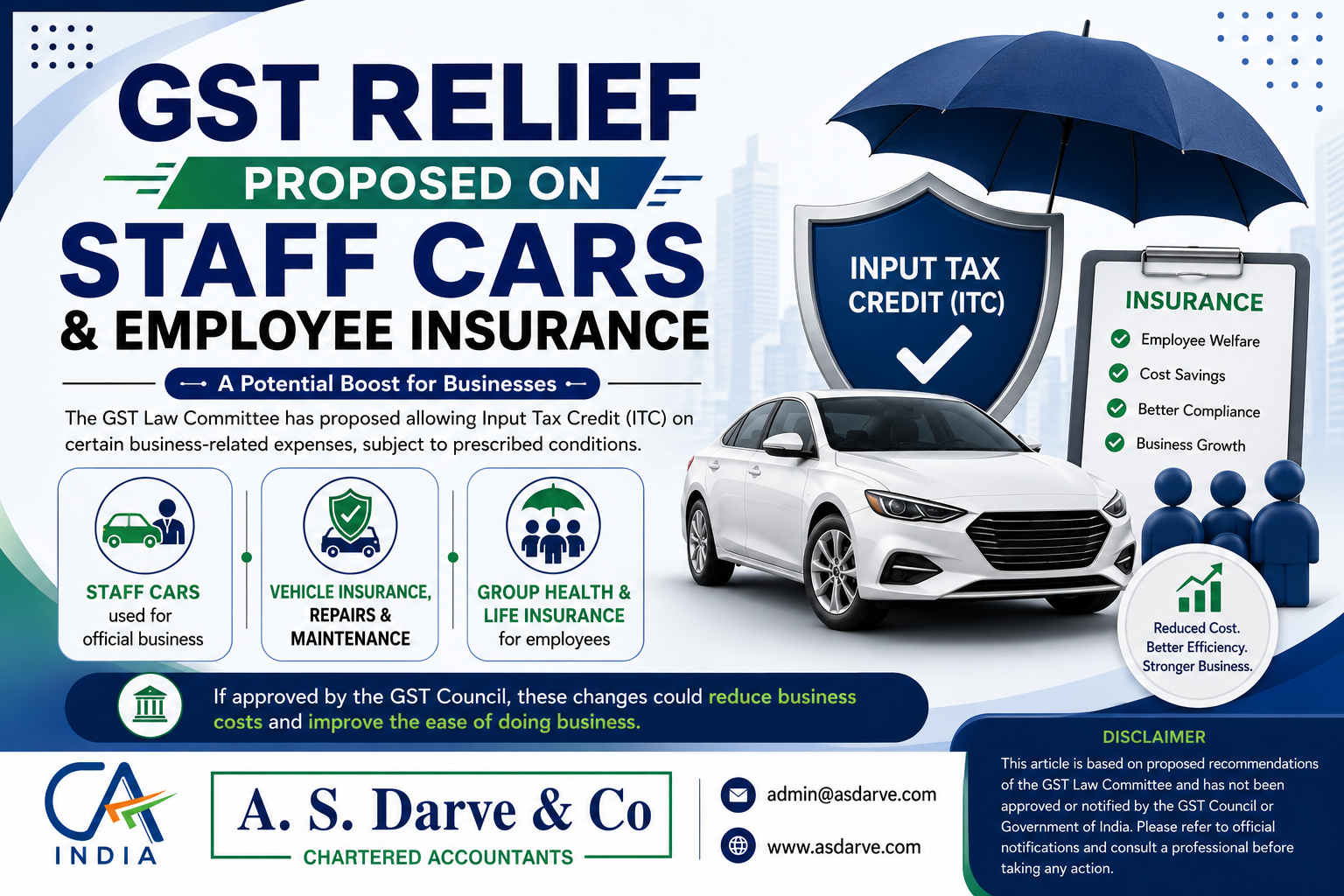
GST Relief Proposed on Staff Cars & Employee Insurance: A Potential Boost for Businesses
The GST ecosystem in India continues to evolve with the objective of simplifying compliance and reducing the cost of doing business. One of the significant proposals currently under consideration by the GST Law Committee is to allow Input Tax Credit (ITC) on certain business-related expenses that have traditionally been restricted.
If approved by the GST Council, this proposal could provide substantial financial relief to businesses by reducing operational costs and improving tax efficiency.
Key Proposals Under Consideration
The GST Law Committee has reportedly recommended allowing ITC on the following expenses, subject to prescribed conditions:
1. Staff Cars Used for Official Business
Currently, ITC on motor vehicles is generally blocked under Section 17(5) of the CGST Act, except in specified cases. The proposal seeks to permit ITC on staff vehicles that are used exclusively for official business purposes.
Potential benefits include:
-
Reduced capital cost of business vehicles
Need help with this? Talk to A. S. Darve & Co. → -
Lower GST burden on vehicle purchases
-
Improved tax efficiency for companies maintaining employee transportation fleets
2. Vehicle Insurance, Repairs and Maintenance
The proposal also covers expenses related to:
-
Vehicle insurance
-
Repairs
-
Routine maintenance
Allowing ITC on these recurring expenses would help businesses reduce the overall cost of maintaining official vehicles.
3. Group Health and Life Insurance for Employees
Businesses often provide group medical and life insurance as part of employee welfare policies.
The proposal recommends allowing ITC on GST paid on:
-
Group Health Insurance
-
Group Life Insurance
This could:
-
Encourage employee welfare initiatives
-
Reduce the cost of employee benefit programs
-
Improve tax neutrality on mandatory and voluntary employee insurance schemes
Why This Proposal Matters
If implemented, these amendments may:
-
Reduce overall business operating costs.
-
Improve cash flow through enhanced ITC availability.
-
Encourage businesses to invest in employee welfare.
-
Remove long-standing litigation relating to blocked credits.
-
Promote ease of doing business by rationalising ITC restrictions.
Present Legal Position
As of today:
-
ITC on motor vehicles is generally blocked except in specified circumstances under Section 17(5) of the CGST Act.
-
ITC on insurance, repair and maintenance relating to such blocked vehicles is also generally restricted.
-
ITC on employee insurance is available only in limited situations, such as where it is mandatory under any law or falls within specified exceptions.
Therefore, taxpayers should continue to follow the existing provisions until any amendment is officially notified.
What Businesses Should Do
Businesses may consider:
-
Reviewing current expenditure on staff vehicles and employee insurance.
-
Maintaining proper documentation demonstrating official business use of vehicles.
-
Monitoring future GST Council decisions and legislative amendments.
-
Consulting GST professionals before claiming any ITC based on the proposed changes.
Conclusion
The proposed relaxation in ITC provisions represents a positive step towards simplifying GST and reducing the tax cost of genuine business expenditures. While the recommendations are encouraging, businesses should remember that these are proposals only and no ITC should be claimed unless the amendments are formally approved and notified by the Government.
If approved, the changes could significantly benefit companies across sectors by improving working capital and reducing the overall cost of compliance.
Disclaimer
This article is intended solely for general informational and educational purposes. It is based on publicly reported proposals and discussions regarding possible amendments to the GST law. The proposals have not yet been approved or notified by the GST Council or the Government of India. The information provided should not be construed as legal, tax, or professional advice. Readers are advised to refer to the relevant provisions of the CGST Act, Rules, notifications, circulars, and official Government publications or seek professional advice before taking any action based on the contents of this article.
Have Questions? We're Here to Help
Get expert advice from A. S. Darve & Co.. Reach out to discuss your requirements.